Filler Words Are Load-Bearing
On qwen2.5-coder:1.5b, compressing verbose prompts dropped average pass rate from roughly 0.89 to 0.28 across the archived compression experiment.
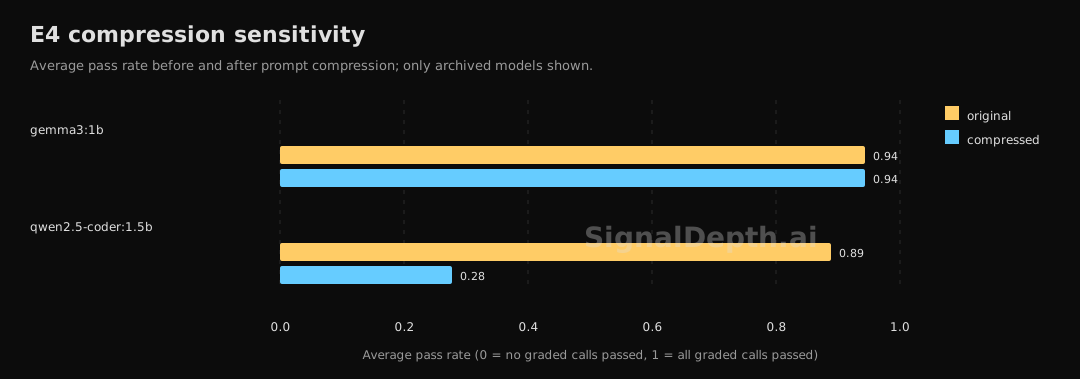
Key Numbers
| Model | Original | Compressed | Direction |
|---|---|---|---|
| qwen2.5-coder:1.5b | 0.89 | 0.28 | Compression hurt |
| gemma3:1b | 0.94 | 0.94 | Flat in this archive |
The destructive cases were not whitespace cleanup. They came from phrase simplification and filler deletion, where wording that looks redundant to humans appears to help small models keep task structure.
Reproduce
The public repo ships the derived summary in data/public/findings.json. The contribution harness currently supports E9 first; a standalone public E4 runner is deferred until the compression layer is published as an independent public implementation.
The published summary is derived from a local/private archived run, not from a checked-in raw experiment dump.
Sample Counts
- 1 archived E4 run
- 2 models
- 6 tasks
- 2 prompt variants
- 24 task/variant rows
Uncertainty Notes
This archive records aggregated task/variant pass rates, not a normalized top-level call count like E7 and E8. Interpret the result as a strong within-archive contrast on small models, not as a claim that compression always hurts.
Limitations
This finding is model-dependent. It should not be summarized as "compression hurts" or "compression helps" without naming the model size and task family.