Specificity Dwarfs Everything
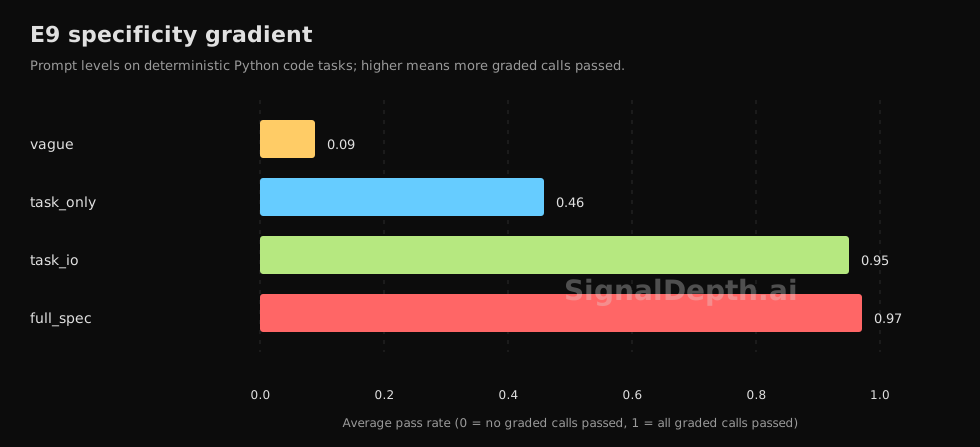
Across the 12 currently aggregated E9 run archives, moving a prompt from vague to task plus input/output spec raised average pass rate from 9% to 95%.
Key Numbers
| Prompt level | Average pass rate | Notes |
|---|---|---|
| vague | 0.09 | Task name only |
| task_only | 0.46 | The task is stated, but shape is missing |
| task_io | 0.95 | Input/output shape and one example |
| full_spec | 0.97 | Adds constraints and edge cases |
The jump from task_only to task_io is the cliff. More detail after that helps much less on the current task set.
Reproduce
cd harness
uv run python validate.py e9 --model-name qwen2.5-coder:1.5b --k 3
Data
- Public fixture:
data/examples/e9_specificity_fixture.json - Aggregated finding:
data/public/findings.json - Task definitions:
harness/data.py
The full raw run archive for this finding is curated privately; the public repo ships the derived summary, plotting code, and fixture instead of the per-trial dumps.
Sample Counts
- 12 archived E9 run files
- 12 models
- 4 tasks
- 48 task-model rows per prompt level
- 576 total graded calls
k=3per condition
Uncertainty Notes
The headline numbers are point estimates averaged across task-model rows from the archived runs. The site does not yet publish confidence intervals, and the archive is still limited to deterministic Python coding tasks rather than open-ended or multi-turn workloads.
Limitations
The task set is deterministic Python coding tasks. This finding does not claim the same effect size for open-ended writing, long-context retrieval, or multi-turn conversations.